Adding the word feminine to the title of a newly launched project—a project designed for a business and corporate setting—can be considered somewhat a bold move. The word can easily be mistaken for something else than intended, and it comes with a lot of different associations.
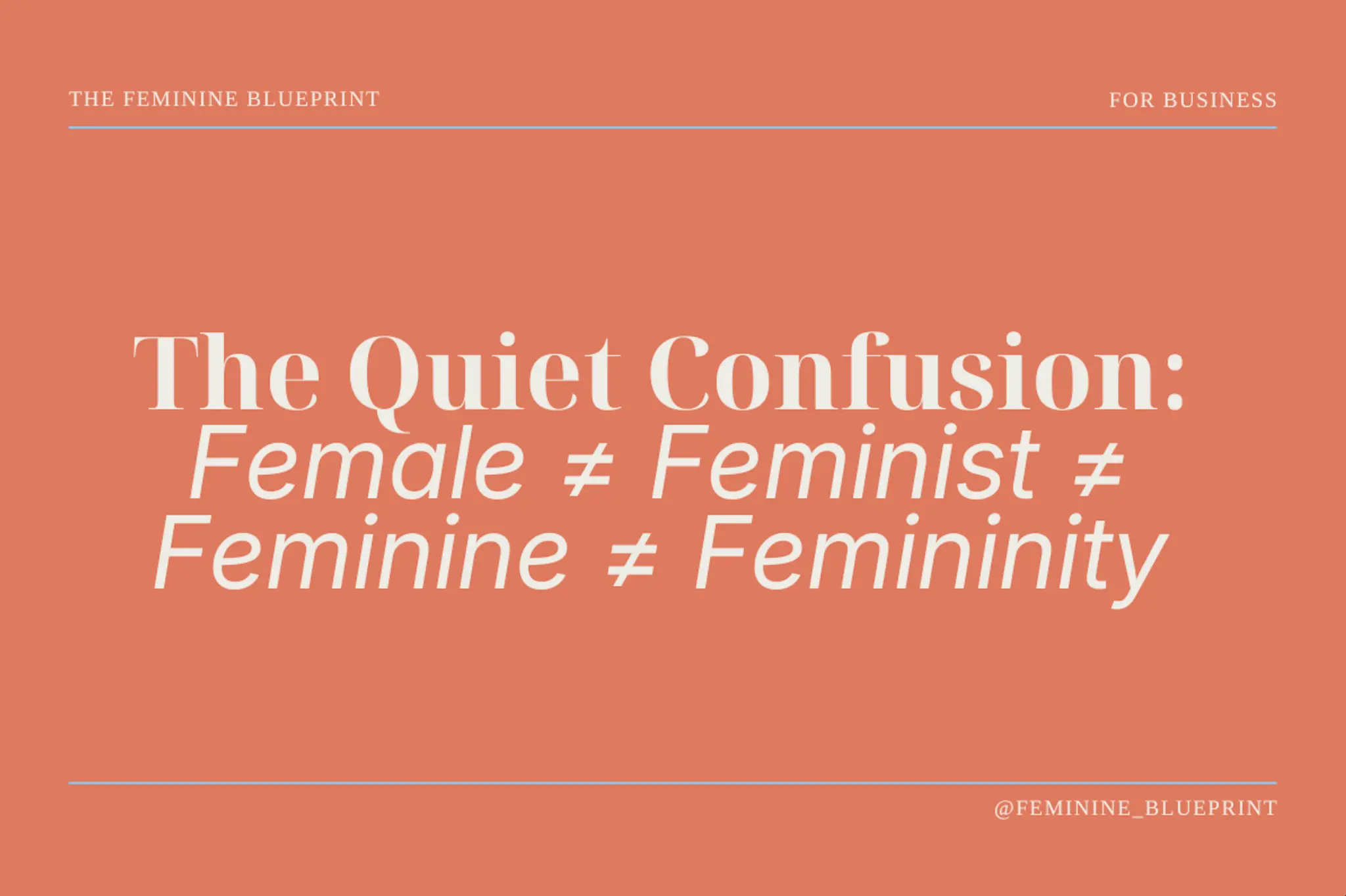
Unfortunately, we tend to mix up the words around all things femme and argue across the definitions without even realizing. There is a quiet confusion; and this is why people come to me saying "I read about your project on female leadership" while the project is in fact about feminine leadership. These are two different things entirely.
- •Female is about who is in the room
- •Feminist is about equality, acknowledgement, who has power and why
- •Feminine is about our operating principles
- •Femininity is about how the feminine is expressed
While clear when listed, there is an unclear use of these words in practice, and therefore an apparent potential for being misunderstood. Despite this, I decided to go for the word feminine for The Feminine Blueprint for Business because 1) in its essence, the project is about the feminine in business... and 2) it opens up an interesting conversation and hence allows the opportunity to talk about the subject at hand; and this is exactly the conversation, expansion and learning I would like to explore and see materializing in the real world, amongst real people and in real organizations.
The Feminine Blueprint for Business is more than a project. It is a mission to change something deeply inside our shared understanding and operating system of business; a dedication to become a voice for the feminine in business and to balance out imbalances that are long overdue.
The Female ≠ Feminist ≠ Feminine ≠ Femininity Struggle
While the confusion on the lingo is understandable, I suggest this: Can the confusion be a sign of a deeper, and more profound issue? The fact that we are not able to fully separate and understand the true meaning of these words by first stance indicates that there is a glitch to look out for; and this glitch might be responsible for a whole lot of important conversations not being taken.
The result? Wrong impressions, blurred understandings, maybe even misunderstandings, and slower progress for potential shifts.
So, to clear this up:
- •Female = biological, demographic
- •Feminist = political, ideological
- •Feminine = psychological, energetic, relational
- •Femininity = cultural, performative, external expression
The Feminine Blueprint for Business is not about female leadership, feminist leadership or showing up in femininity. It lives entirely in the realm of the psychological, energetic and relational qualities of the feminine.
It explores selected human energies, defined broadly as feminine qualities, the importance of these in a business context, the neglect they have been subject to in modern history and actionable steps to infuse them into the way we build organizations, design products, relate to our clients, support our teams and act in our leadership.
Feminine Leadership in Its Essence
With the feminist movement, #MeToo, discussions on gender equality in business, female leadership communities, female founders, women's circles, female biology and health, matriarchy; we are talking a lot about women. By now, these tensions, developments and trends are tangible to us—they have entered the radar for good and we have started expressing and building our language around what it means to be a feminist or a woman.
However, there are also the tensions that we might feel, but struggle to actually see and articulate. As a set of psychological, relational and energetic qualities, the feminine often belongs to this category, and especially for business, the feminine has not been extensively recognized. Furthermore, it has been silenced to a great extent. Not on purpose, but as a result of history. The reason? We have basically been taught to toughen up and do business according to a certain set of principles—and due to this, our language, models and recognition of the qualities of the feminine still lack proper acknowledgement.
To take it one step further and enhance your understanding of feminine leadership, it can be explained in this way:
Feminine leadership prioritizes meaning, relationship, and long-term vitality over control, speed, and short-term extraction. It is looking through the lenses of empathy and relational and emotional intelligence, leading in a way that keeps people, systems, and purpose alive. It is oriented toward coherence rather than dominance. It is the capacity to lead without severing connection to people, purpose, nature and life.
Any gender can lead from their feminine. Everyone has access to it. For some, it comes more naturally, for others, they need to learn. But that is how it is with all kinds of qualities, is it not?
The Backbone of Our Shared Understanding
I think it is fair to establish a common agreement that our corporate upbringing has been formed on the basis of more men than women; more on predominant masculine principles, rather than feminine. Let us try to replace the wording:
- •Male is about who is in the room
- •Masculinist is about... it is not really a used word because a masculinist movement was historically not needed in corporate or academic discourse
- •Masculine is about operating principles
- •Masculinity is about how the masculine is expressed
What is interesting to me (other than the fact that there is actually no mainstream and commonly-used equivalent to the word feminist because it was never needed...) is that the masculine forces are so easy for me to name and understand in a business setting, i.e. drive, strategy, analytical thinking, ambition, expansion, execution, growth mindset, decisiveness, speed and linear work processes.
I know what these are. I have learned them, integrated them, made them shape my whole world—and I am honestly happy that I learned this, because it surely does come with a lot of great qualities, and did make me understand that section of the balance sheet.
However, when I am thinking feminine and corporate in the same sentence, the list of words and understanding comes less easily to me; and more profoundly, I struggle to see and name the language and actions established from, assigned to, or based on specifically the feminine. It is there in bits and pieces, but it is subtle and quite silent. Slowly resurfacing. That despite the concept of the feminine predating modern gender politics by far.
To me, while I appreciate having learned so much from the masculine and from the traditions of business, I am saddened to find myself and so many others disconnected from this other side of us. Aligning with values, meaning over profit, choosing long-term health over short-term gains, dialogues over debates, responsiveness rather than force, respect for natural rhythms, patience, regeneration, intuition-based versus purely data-driven, responsibility for impact, holding space rather than directing, psychological safety.
Sounds like the exhale we all need after a very long, masculine inhale that eventually seems to strangle many of us in the corporate world?
This is what I am voicing: Gender, politics, ideologies and physical expressions aside, how does the feminine show up in business? Is it allowed space? Have we established a common understanding of its definition and role; and more importantly, acknowledged its true value to our organizations? Are we willing to now start learning again, collectively making the feminine just as recognized as the masculine in business?
While very foundational, we have to start here, at the base: With understanding the words we use, as they shape our world.
Curious to explore this further? Apply for one of the free seats at the online The Feminine Blueprint for Business Experiment Summit February 19th → Apply here